
Accelerating Discovery: Insights from the Falling Walls Circle on Imaging in the Age of AI
We are delighted to announce that the 2025 Falling Walls Circle discussion between Professor Paul Matthews, Director of the Franklin, exploring the Future of Imaging in the Age of AI, has now become available online. For the discussion,Paul joined Professor Martin Hetzer, President of the Institute of Science and Technology Austria (ISTA), Stephani Otte, Biobhub, and Professor Jason Swedlow, also part of Biohub, on the panel, which was chaired by George Caputa from Springer Nature.
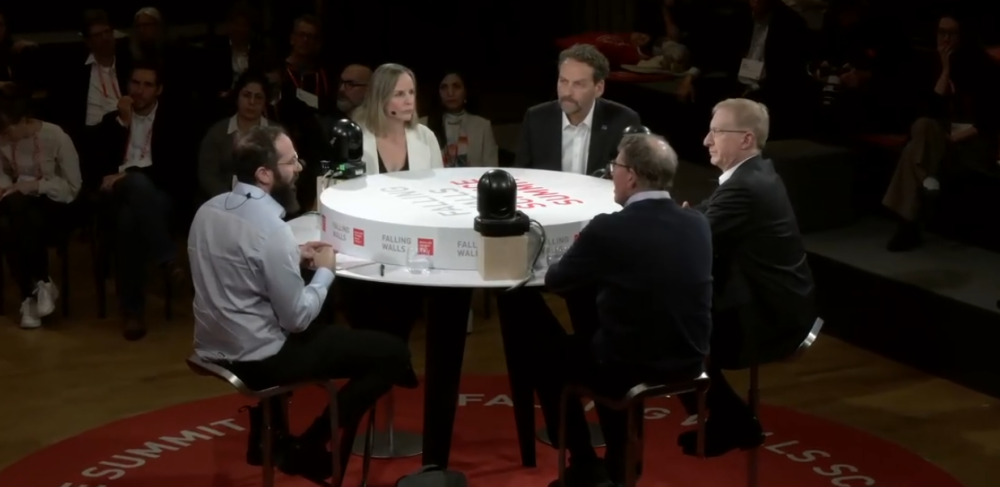
The panel discussion was delivered to a live audience as part of the 2025 Falling Walls Science Summit in Berlin. The Falling Walls Science Summit has been bringing global science leaders, business pioneers, and public sector visionaries together since 2009 to share knowledge, foster collaboration, and shape the future of the international innovation system. Read more about the Falling Walls Science summit here.
The panel explored the importance and growing impact of AI models in helping to accelerate discoveries as the scale and complexity of imaging data grows. They also reflected how advances in AI models in conjunction with advances in imaging science will be needed to improve our understanding these biological systems better and aid discovery of new therapeutics.
In the discussion, Paul noted, “AI is now transforming the way we image. We’re reaching physical limits in many of the tools we use for imaging and what AI is helping us do is transcend those by integrating the prior knowledge that we have from all of the other images that we collected before… bringing greater resolution and meaningfulness to the image.”
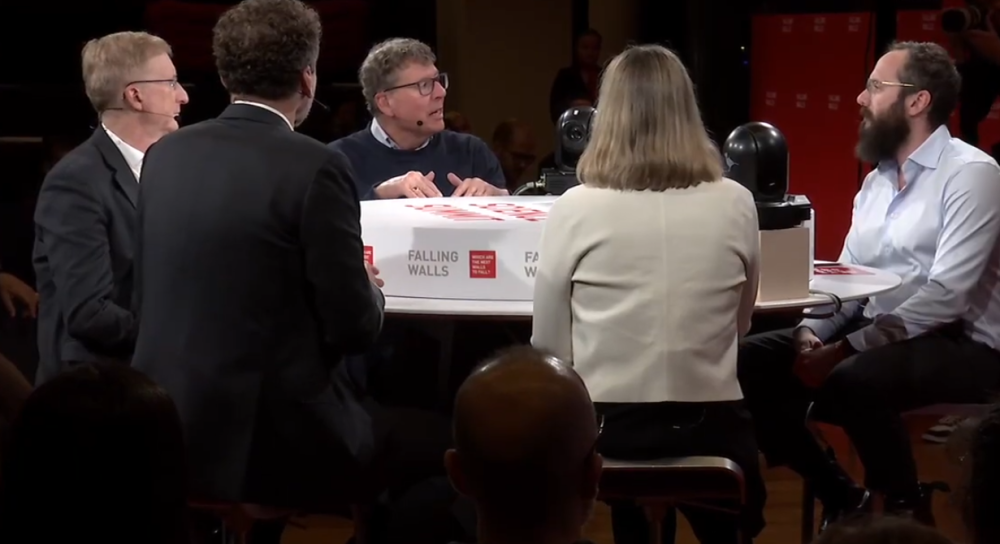
Paul highlighted the need to work across disciplines to be able to achieve these advances: “We need to break down the distance between the people that make the models and the people that use the outputs of the models because a critical step in making a model is how one is going to take that image and encode the data [and] features in it in a way that can then be used in an AI model …That encoding step is fundamentally determining what kinds of features are highlighted by the model…We want people going forward to really know how that output was generated: what features were used and why.”
A particular focus for imaging applications of AI in the Franklin has been to reduce artifacts, boost effective resolving power and enhance the molecular information that can be extracted from cryo electron tomography. The Franklin is working in collaboration with the Chan Zuckerberg Initiative and other partners to build a global community to both accelerate the development of tools for cryo electron tomography discovery and enhance training to diffuse their benefits more rapidly.
Volume electron tomography is a cutting-edge technology that is rapidly evolving with the support of AI. However, it still is not widely available, limiting the ability of scientists to learn how their own research can benefit from accessing it. The Franklin team is working not only to advance technology and algorithms, but also to catalyse the aggregation of the previously fragmented technical community to improve training in methods and lower barriers to training and use of the technology by the wider scientific community.