
Celebrating Sustainable Lab Practices
Two Franklin laboratories have achieved Laboratory Efficiency Assessment Framework (LEAF) certifications, marking their commitment to creating sustainable and efficient laboratory environments. Laboratories contributing to around 2% of global plastic waste and using three to ten times more energy per meter squared than a standard office. LEAF, an international standard developed by University College London, helps research organisations to tackle this challenge, reducing environmental impact while maintaining high scientific standards.
LEAF guides laboratories through a series of actions designed to integrate sustainable practices and improve efficiency of laboratories. The framework focuses on five key categories: waste, people, sample & chemical management, equipment and ventilation.
Labs work towards bronze, silver or gold certification levels, each representing increasing levels of environmental impact and sustainable performance. The framework encourages teams to start with simple behavioural changes, then optimise equipment and workflows, and finally embed longer‑term sustainability practices across the laboratory.
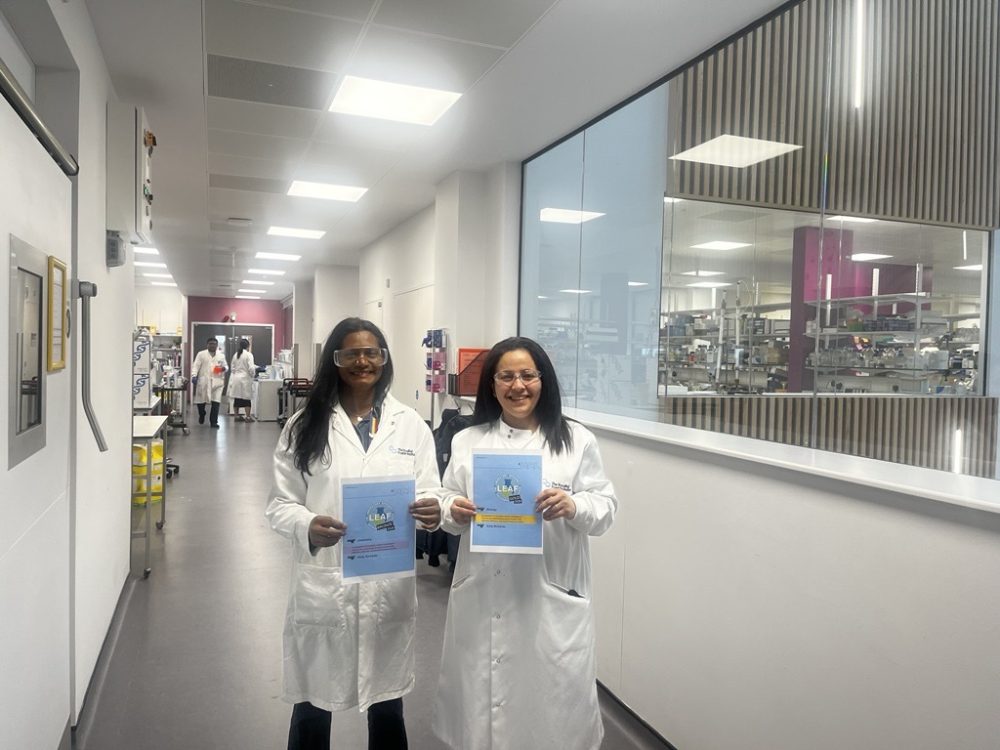
Biology Lab – Gold Certification
Biology Lab Manager Sheera Abdulla shared her experience.
“The sustainability journey in the Biology labs began with a workshop run by the Mary Lyon Centre in MRC Harwell, attended by the technical team in September 2022. The workshop was a real eye-opener, highlighting several common yet easily avoidable practices and demonstrating the significant impact they can have on the environment.
Some changes were straightforward, such as choosing UK-based suppliers instead of overseas options when local alternatives were available. Other steps required more research and engagement with scientists, for example changing freezer temperatures from −80 °C to −70 °C. This involved presenting supporting evidence from published studies and examples of best practice from other institutes, showing no negative impact on sample integrity.
There were also measures whose importance was not immediately obvious but proved to be highly effective. Implementing a proper freezer inventory system, alongside racking, improved accessibility to samples and reduced the time freezers were left open, leading to measurable energy savings.
Overall, this has been a very enjoyable and rewarding area to work in. Crucially, support from senior management—particularly in allocating dedicated time—has greatly enhanced the experience.”
Chemistry Lab – Bronze Certification
Chemistry Lab Manager Mellisa Govender-Kirkpatrick shared her experience
“The Chemistry labs started working towards the application for LEAF certification in April 2025, by introducing small changes that the lab could take to minimise the impact on the environment. These small changes included setting all lab PC screens to go to screensaver after five minutes inactivity, having stickers on equipment to remind users to turn off equipment after use, cleaning fridges and freezers regularly and having end of the day walkabouts to spot any potential energy wasting practises.
Towards the end of 2025, once the team were confident that we could securely demonstrate the requirements for the Bronze LEAF certification, we applied for Bronze level. In January 2026, we had a successful LEAF audit visit and gained a Bronze certificate.
After this first milestone, the team have been spurred on by this achievement and are looking go even further – we are now aiming to go for Gold certification by the end of 2026!”
The Franklin continues to strengthen its sustainability practices, with LEAF participation expanding across all laboratories at the Institute. These achievements highlight the dedication of our technical teams and their commitment to embedding responsible research practices into daily laboratory work. As we build on this progress, the Institute remains focused on reducing environmental impact while supporting world‑leading science.