
Researcher Spotlight: Narain Karedla
Staff Scientist, Narain Karedla, has recently embarked on a new course of research as a group leader through a European Research Commission starting grant between the University of Oxford and the Franklin. Narain’s grant, called MIETEN (Metal-Induced Energy Transfer based Electrometry and Nanometry), focusses on developing new optical microscopy methods, to understand the role of electrostatics in biological processes. As an ERC Fellow, Narain is building a team that will develop a new tool set to answer fundamental questions like how electrical charges on molecules make them interact, and how membrane surface chemical properties influence biological processes for example, in cell–cell communication, molecular trafficking, phase separation, etc. These new optical methods will be complementary to the BioCOP (Biophotonic Correlative Optical Platform), a technology recently built by Narain during his staff scientist position and will be used to understand the role of electrostatics in immune cell response.
“I realised during the course of the last couple of years that there’s a technological gap, where there are on one side methods that can measure the dynamics of molecules at single molecule level, and on another side few recent methods that can measure the electrical charges of molecules, an area which I have also contributed to, but these two things cannot be done simultaneously. The grant aims to solve this technological gap and look at how the charges of molecules affect their behaviour to understand fundamental biological processes. One aim is to dissect the role of membrane chemical properties in molecular trafficking, specifically how proteins and viruses interact with and bind to membranes as a function of membrane charge. In this regard, often in biology, an important question is how molecular perturbations such as point mutations or post-translational modifications change their trafficking behaviour.
Apart from the fundamental applications, the methodology and the results can be directly translated to biomedical applications offering ways to quantify the binding of small molecules to their targets in the membrane, to study the role of molecular perturbations by establishing charge-structure-function interrelationships, and aid in designing therapeutics. Some of the applications I mentioned sit in the context of immunotherapies, where cell–cell interfaces form dynamically and remodel under strong electrostatic and steric constraints. We want to understand how charge distributions, especially those arising from charged lipids, glycocalyx components such as mucins, alter membrane mechanical properties, influence intermembrane forces, and tune the dynamics of recognition and signalling at these contact sites. Mucin molecules, for example, on the cancer cells, are bulky glycoproteins which are also highly negatively charged. And so far, many questions related to how they would impact the immune cell interactions are outstanding. This is also where industry becomes relevant: we can move from fundamental mechanisms to translation by turning these measurements into medically actionable insights. At the molecular level, the aim is to link structure to charge distribution and quantify how that coupling affects their behaviour and function.
I’m deeply grateful to the European Research community, as well as the Rosalind Franklin Institute and the University of Oxford for recognising and supporting this research. This project gives me the independence to develop my own research programme, empower new young scientists, and find solutions to address the current technological gap, empowered by collaborations within the host institutes and researchers around the world. I’m highly excited to get started and to see where the work leads. This internationally recognised grant supports an important set of questions that need answering.”
About Narain:
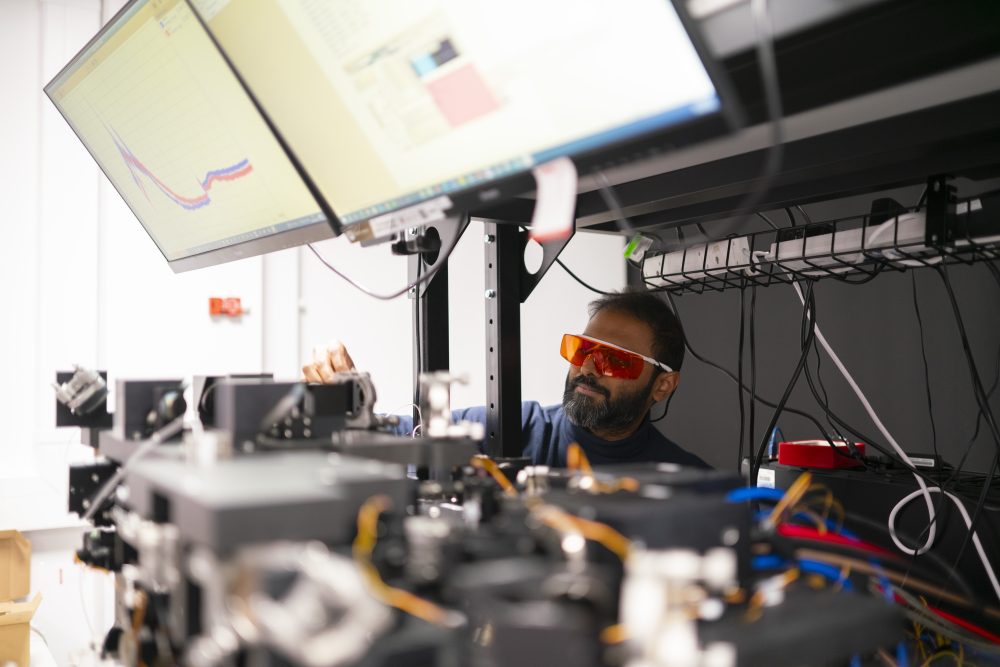
Narain has a background in Chemistry from the Indian Institute of Technology, Roorkee, India and is motivated in developing and exploring new advance optical microscopy tools for biophysical applications. He was first exposed to biophysics during his undergraduate degree when he learnt about fluorescence microscopy as a way to look at the dynamics of molecules. Following his doctoral studies at the University of Goettingen with Prof. Joerg Enderlein and postdoctoral training in Oxford in the lab of Prof. Madhavi Krishnan, Narain started as a postdoctoral researcher at the Rosalind Franklin Institute around four and a half years ago to build a unique microscope platform, BioCOP. BioCOP combines the latest state of the art technology of lattice light sheet imaging and structured illumination microscopy to image cells in their native states and quantify nanoscale processes.
“It was a great opportunity for me to be a part of the Biophysical Immunology group led by Prof. Marco Fritzsche, to develop my optical skills, and to apply it to the challenging field of immunology, especially to better understand the biophysics of the immune response and how our immune cells work within the disease context. Since then, I have been promoted to staff scientist, and alongside building the platform, I am also utilizing the optics expertise to design new microscopy methods. I am applying BioCOP across a range of projects in immunology and beyond, both within the Franklin and with external collaborators. I look forward to combining BioCOP and MIETEN together and shed light into many open questions”