
From crystallography to microscopy: reflections from IUCr and IMC21
Scientific conferences play an important role in advancing research by bringing people together to share new findings, exchange ideas and learn about emerging techniques. They also create space for researchers at every career stage to receive feedback, build networks and develop collaborations that can shape future work—particularly across disciplines where different perspectives and approaches can spark new possibilities.
2026 marks an unusual conference season as both the International Union of Crystallographers (IUCr every 3 years) and the Royal Microscopy Society (IMS every 4 years) have their big international conferences in the same year. Two Franklin researchers, Senior Scientist Marcus Gallagher-Jones and PhD student Gloria Gao were fortunate enough to get the opportunity to present at both as their research sits at the interface of crystallography and electron microscopy.
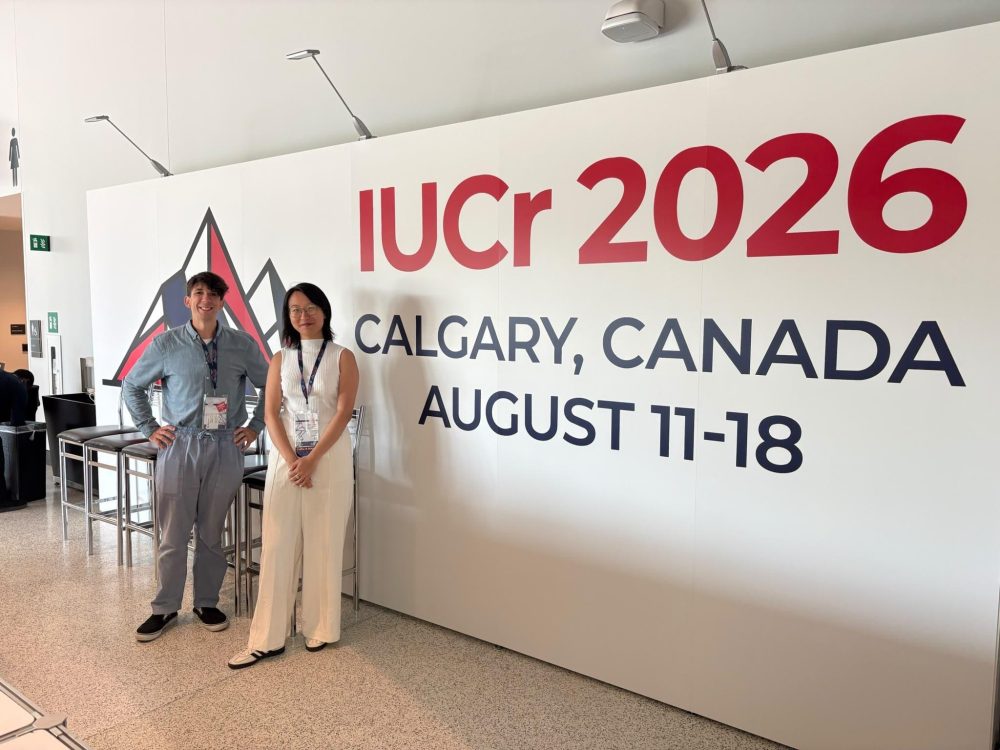
The twenty-seventh Congress and General Assembly of the IUCr held at BMO Centre in the blue-sky city of Calgary, Alberta. This triennial international conference of structural science was well-attended, gathering more than 1800 attendees representing 55 countries from around the world. Scholars, scientists and students from academia and industry contributed to 142 microsymposia, 21 workshops, 26 keynote speeches, 7-day software fayre and 3 plenary lectures. The congress programme featured a wide range of topics from quantum crystallography, magnetic structures, crystallography in art and culture heritage to complimentary methods like NMR and cryo-EM.
The 21st International Microscopy Congress was held much closer to home in the historic port city of Liverpool in the newly built experience centre sitting alongside the Royal Albert Dock. Being the frontier conference for all things Microscopy the quadrennial conference attracted over 3000 attendees from over 50 countries presenting in 32 different symposia over 4 days. In addition, there were representatives from over 120 different exhibitors showcasing all the new technologies that had been developed over the past 4 years.
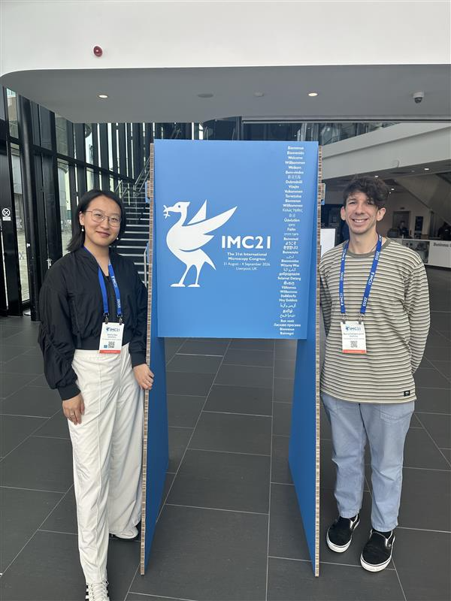
Marcus’s reflections:
I feel incredibly lucky to have been invited to talk about the work I do at the Franklin at both conferences as it is a great opportunity to showcase my research to two quite different audiences. Despite being a crystallographer for many years this was my first time attending an IUCr congress and it didn’t disappoint. What really struck me at IUCr this year was the real growth in interest in MicroED/Electron diffraction in general. What was once quite a niche technique is becoming more mainstream with several dedicated microsymposia and selected talks in many others. I was also struck by the growing push for incorporating dynamics into our structural studies to really probe how the molecules of life function.
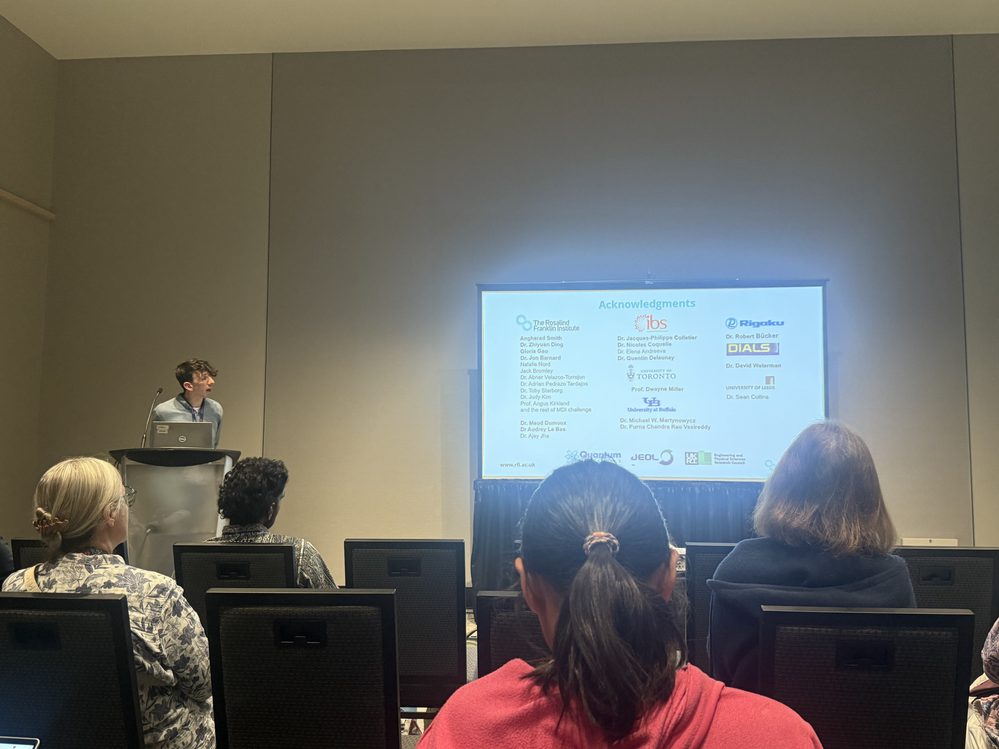
Beyond the talks it was also an excellent opportunity to catch up with colleagues old and new, strengthen existing collaborations and forge new ones. Being immersed in all things crystallography for 10 days was a real treat and I’ve come away with many new ideas and potential collaborative projects to push the ED work we do at the Franklin even further. I’m particularly excited about the rising interest in ‘in cellulo crystallography’. This session, often thought to be a biological oddity, was standing room only and a clear area where electron diffraction can make a real impact in understanding how cells control the ordered assembly of macromolecules.
IMC had quite a different tone. Being a shorter conference the schedule was much more packed. However, there were still plenty of amazing talks and posters to see, particularly in 4DSTEM and Ptychography which has really exploded over the past few years. It was gratifying to see such a large Franklin presence at the conference demonstrating that we are really at the leading edge in terms of technology development for Microscopy.
Gloria’s reflections:
At IUCr, the scientific programme was exceptionally rich. I was particularly glad to have attended sessions on emerging techniques such as 4D-STEM and time-resolved serial crystallography. These sessions drew massive crowds, resulting in standing-room-only rooms, highlighting the progressive interest and rapid development of the respective fields. I also enjoyed the sessions “engaging all in crystallography” and early-career talks, in particular, the talk on the design and implementation of a crystallography boardgame!
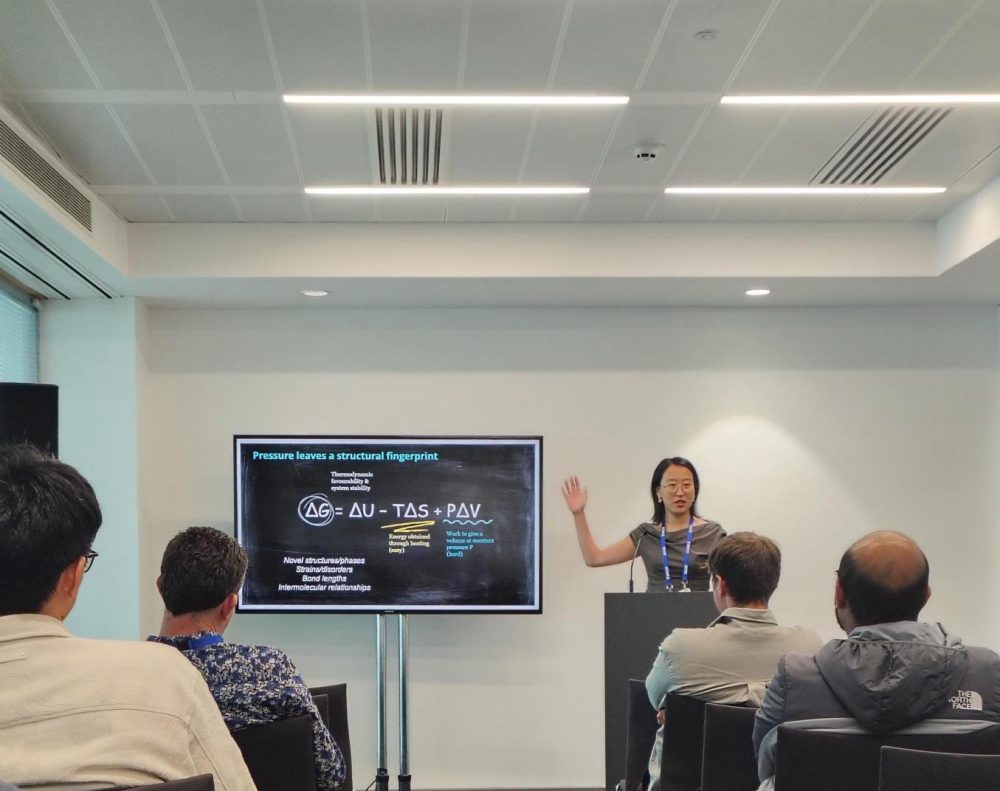
I was fortunate to have presented my PhD work to date in IUCr, where I discussed how microED sample preparation can be enabled by graphene-generated pressure and confinement. Presenting my work on a big stage for the first time was challenging and rewarding, and it allowed me to receive valuable feedback from leading experts in the field, as well as stimulating discussions with crystallographers which I will be sure to consider and incorporate into my future work.
At IMC21 – an international conference albeit closer to home base in the city of Liverpool – I presented my work in the form of a poster. It was very interesting to see the same science being understood and received by a different crowd, and the different conversations that sparked from it. In addition to attending talks, I enjoyed attending the exhibitors to understand the current developments in software and hardware related to electron microscopy.