
Why Discovery Matters
This piece was written by our Director, Professor Paul Matthews.
The Rosalind Franklin Institute was created to pursue an ambitious mission: harnessing physical sciences methods that could transform life sciences. To realise this mission, we are developing new ways to image cells in their native tissues, creating technologies to selectively modify functions of proteins inside living cells and building AI tools able to build on these data to generate quantitative descriptions and predictive models of how cells work. With success, these capabilities will allow us to explore one of the great frontier areas in science: understanding life at the level of the cell.
When I first arrived at the Franklin, it struck me immediately that most of the science was not addressing specific questions so much as providing entirely new ways of seeing living processes in cells and tissues. Technological advances were revealing landscapes that were previously invisible. The improvements in imaging resolution and sensitivity or analytical power were opening doors that – prior to their advent – we did not even know existed.
It is remarkable to reflect on the fact that imaging the ultrastructure of cells directly in human tissues at near atomic resolution now has become routine within the Institute! And that the recent advances in STED super resolution microscopy are revealing the exquisite organisation of cell-cell interactions and their dynamics in living human cells and organoids. They are not merely providing better pictures. They are opening the way to new understanding in biology.
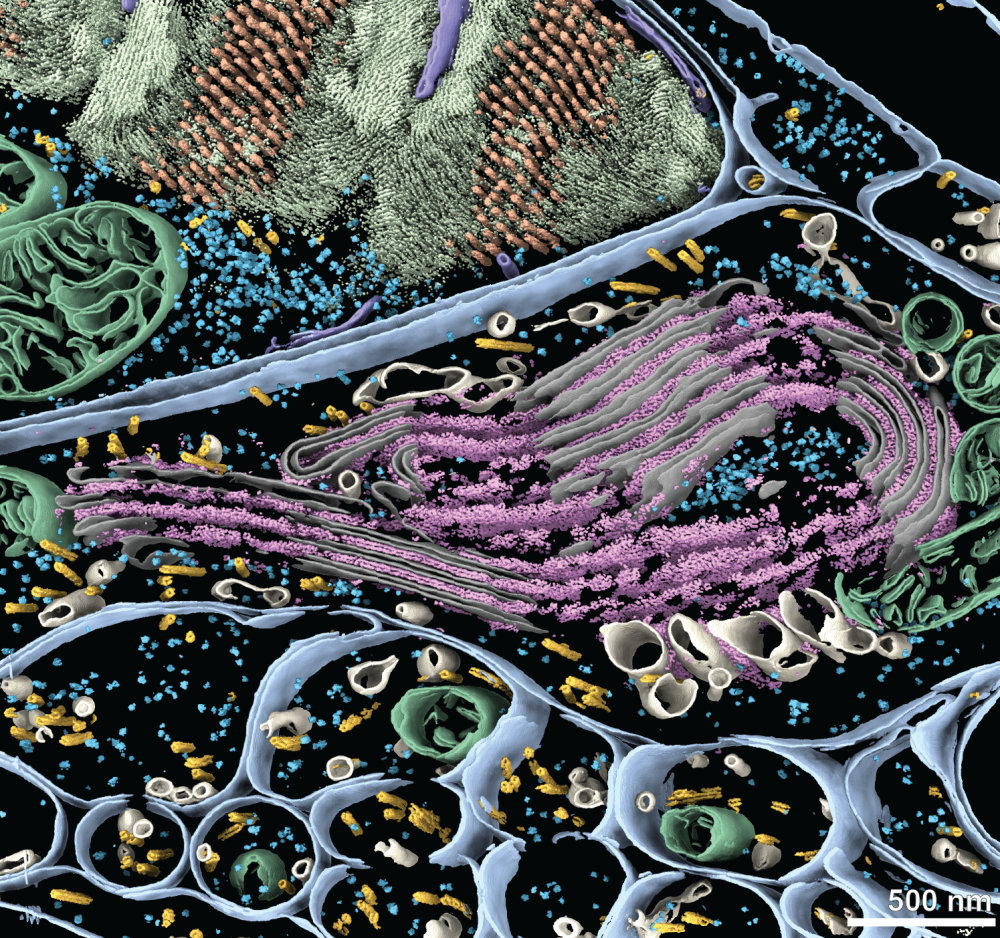
Authored by Helena Watson and Victoria Garcia-Giner from the group of Michael Grange at the Franklin in collaboration with Susanna Cogo at the University of Reading and Fabian Eisenstein at ETH Zurich. For more details on this work, please see the biorxiv paper.
As an undergraduate, one of the books that most influenced my thinking was Erwin Schrödinger’s What is Life? In it, Schrödinger argued that living systems should ultimately obey discoverable physical principles. That idea inspired generations of scientists. The discovery of the structure of DNA was one profound step towards understanding those principles, but the journey is far from complete.
There should be no doubt but that we are living through another transformative period of discovery. By combining advanced imaging, innovative chemistry and artificial intelligence, we are beginning to uncover the rules that govern how cells are organised, how they communicate, how they evolve with development or aging and, ultimately, how disease emerges. Some of these insights will arise from direct extensions driven based on known biophysical principles. Others will emerge iteratively through the partnership between human creativity and increasingly capable AI. Neither approach will supplant the other. Together they allow us to ask questions that neither could answer alone.
Discovery, however, is never accidental. It requires curiosity, but it also requires focus. The opportunities before us are almost limitless, and we cannot pursue all of them. We therefore must choose the questions that matter most – where our technologies can reveal something genuinely new. Curiosity remains one of our most powerful guides. Scientists who are driven by a deep curiosity about how the world works are usually those who make the discoveries that change it!
Discovery is valuable in its own right. Expanding human knowledge has always enriched society. But as a publicly funded institute we also have a responsibility to ensure that our discoveries create benefits beyond our scientific communities and laboratories. Our mission therefore should be viewed as including transforming life science in ways that accelerate the development of new diagnostics, technologies and treatments.
These applications of our science should never be seen as an alternative to discovery science. Translation is built upon discovery. Every new medicine, every transformative technology and every improvement in healthcare begins with someone seeing something that no one has seen before or understanding something that no one has understood before.
That is why discovery remains at the heart of the Rosalind Franklin Institute.
If we continue to reveal biology in new ways, ask ambitious questions and pursue answers with creativity and rigor, then we will not only deepen our understanding of life. We will create the foundations for the innovations that will improve lives for generations to come.