
New nanobodies target a vulnerable part of SARS-CoV-2 that rarely changes
Scientists at the Rosalind Franklin Institute and collaborators have identified a new way to stop the virus that causes COVID-19 (SAR-CoV-2) from infecting cells, and other closely related viruses. Their research reveals a pair of tiny antibodies, known as nanobodies, that target a part of the virus that has remained almost unchanged as the viruses have evolved.
Most antibody treatments developed focus on the tip of the virus’s spike protein, which it uses to attach to human cells. However, this region evolves rapidly, allowing new variants to escape existing treatments. The researchers instead focused on the lower section of the spike protein, called the S2 region, which plays a crucial role in helping the virus fuse with and enter cells. Because this region changes very little between variants, it is a promising target for longer-lasting therapies.
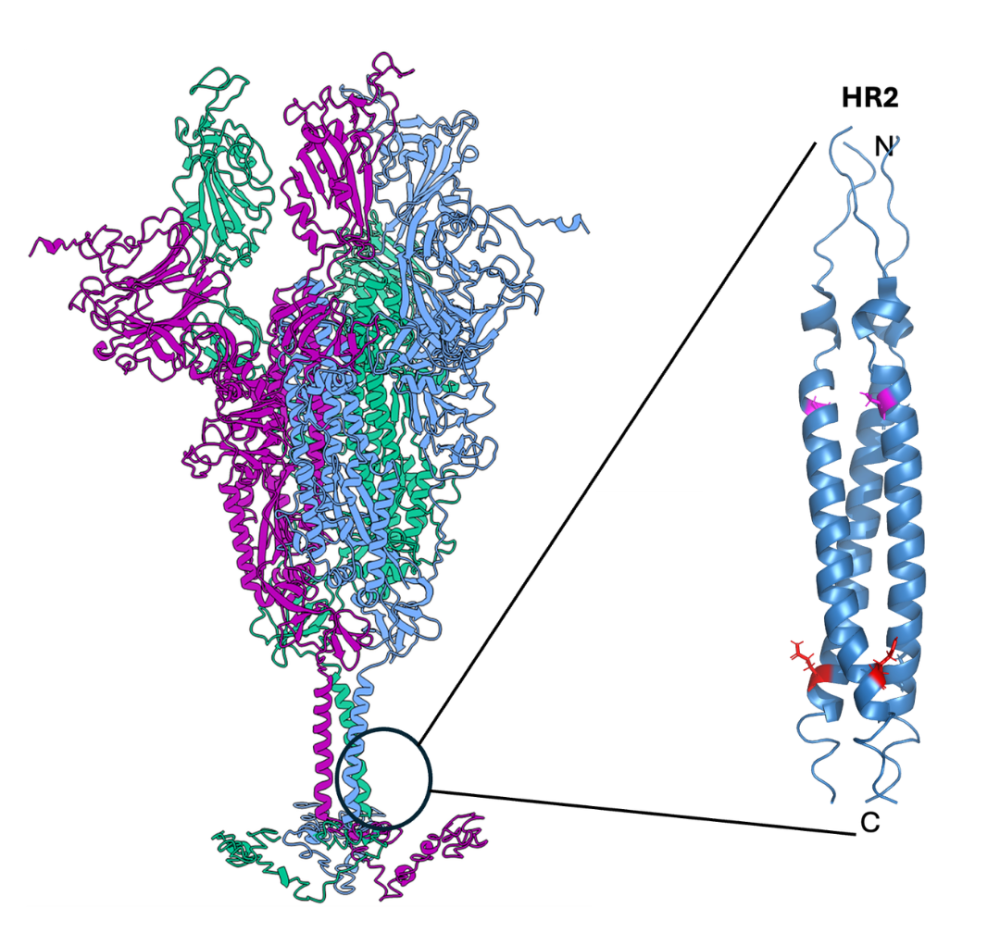
A major challenge for antiviral therapies is viral escape, where mutations allow the virus to evade treatment. While individual nanobodies could eventually select for resistant viruses in the laboratory, combining the two nanobodies, that enable dual binding, the team prevented escape mutations from emerging. This suggests that therapies targeting multiple sites within the conserved HR2 region could remain effective even as the virus evolves.
Miles Carroll, Professor of emerging viruses at the University of Oxford and a project collaborator, said “A therapeutic based on these unique nanobodies has the potential to transiently protect high risk immune-compromised patients who are not able to respond to SARS-CoV-2 vaccination.”
An advantage of nanobodies is that they are much smaller than conventional antibodies, allowing them to reach targets that are often difficult for larger antibodies to access. The two nanobodies attach to different positions within a section of the spike protein known as HR2, which acts like part of the molecular machinery the virus uses to enter cells.
Professor Ray Owens, senior author on the paper and Challenge Lead for How pathogens interact with human cells, said: “By targeting a part of the virus that is essential for infection and highly resistant to change, this work highlights a promising route towards future antiviral treatments that could remain effective against emerging variants and potentially related coronaviruses.”
The team tested the most potent nanobody in hamsters infected with SARS-CoV-2. Animals treated with the nanobody had lower levels of virus in their lungs, less lung damage and reduced weight loss compared with untreated animals. The strongest protection was seen when the treatment was delivered directly into the nose before infection.
This pipeline was developed under the Disease X project, funded through Wellcome, and demonstrates a capability which could be quickly mobilised to create an antiviral therapeutic in the case of another pandemic.
This work is closely linked to ongoing work in the Franklin’s Life Science Challenge – How pathogens interact with human cells, which aims to discover new ways of detecting, preventing and combatting human infectious diseases by discovering the mechanisms by which viruses and bacteria interact with human cells and tissues. Find out more about this challenge here.